Saturday, 28 February 2015

Video Entry #10 - Pre-Production Reading Notes

Research

- "The nature of your subject will be influenced by a number of factors which will vary, depending on the context in which you are working which could be anything from your fist year at college to trying to get you first professional production off the ground."

- "Think about what media/articles/books already exists on your subject – don’t reinvent the wheel. How you can show the familiar in an unfamiliar light? The element of unfamiliarity might come from the style or from the point of view (i.e. showing a situation/event from an unexpected perspective). Try to avoid reproducing stereotyped or clichéd representations of topics, people and places. Your initial research should help to unearth unexpected aspects of a topic, person or place."

- "As you write your treatment follow your instincts – don’t forget what it was that interested you most about your subject. Have you got lost in unnecessary detail/padding? How can you convey what really struck you in images and/or sound? What is your point of view of on the subject and how will this come across?"

Research and Development

- "RESEARCH AND RECCE
• Every film needs it.
• Be open minded, be aware of your own judgements and prejudices.
• Talk to a diversity of people and record all interviews.
• Read and read
Read everything related to your subject: research, literature, poetry,
newspapers and magazines. You must aim to become an expert in the
subject you are dealing with.
Get your facts right.
• While on location, think in pictures, make the film in your head.
• Make notes on light and sound.
• Pay attention to the practical side of things, parking, availability of electricity,
pubs, toilets etc.
• The most interesting shots are those where things are actually happening, so
note the time of those actions you need for your programme.
• Do you need permission to film? Check?
• Keep a note book"

Doing a Recce

"These are the key issues you need to think about in doing a Recce.
Conceptual
• What will the location add to your ideas?
• What will its use contribute to how your subject(s) are seen?
• What visual possibilities does it offer?
• How might you use features of the space/ in your sequence?
• What aural possibilities does it offer? How might the various sounds
available be used creatively to convey atmosphere/meaning?
• How might background people feature?

Location Shoot Checklist

"Equipment:
1) Gun mic
2) Camera (DRS 250)
3) Tripod
4) TAPE
5) Lights, if necessary (and 4 way power splitter)

Set up check:
1) Set spirit level on tripod
2) Switch off auto settings on camera
a) Iris, front right.
b) Focus, back of lens left
c) Auto switches (ATW etc), body left.
3) ND filter set to ‘off’- indoors; 1 – outdoors; 2 – outdoors bright sunshine
4) Check white balance (set by holding white card up and flicking switch directly
under lens) White balance switch, body left, should be set to A or B for this.
5) Focus properly by zooming in fully first.
6) Plug mic into audio channel 2
7) Set audio ch 2 to ‘manual’ and ‘rear’.
8) Check audio levels with headphones plugged in to camera handle.
9) To adjust brightness of picture turn back ring on lens.
10) Gain switch, body left, should be set to Low (L) unless in low light conditions
(indoors without lights for example)
11) Make sure camera is set to 16:9 ratio (hold down menu switch and turn
camera power on – scroll trough menu until you find the 16:9 Wide option)

Remember to frame your subject properly, no huge gaps above the head and no
clutter or distracting objects in the frame. Zoom in to fill the frame well so they
don’t seem too far away."


Friday, 27 February 2015

Video Entry #9 - Actual Presentation and Notes

Here is a link to our presentation: Mouth Presentation

This is the script we used for our presentation. All mine are underneath Ben whilst the others worked on their scripts individually

Idea Development - Slide 2 - George

The idea of making a documentary on ‘the mouth’ wasn’t put forward by anyone in our group. But we’re all intrigued upon the idea of the subject because of its great potential and numerous approaches to it. Since the mouth is part of a person, or a place on a person, the idea meets the criteria of the project brief. Now that we had our initial idea, we then had to develop upon this idea in terms of how to structure our documentaries narrative. 


Logistical Planning/Creative Development - Slide 3 - Ben

The first thing we did as a group to develop our ideas was to create a mind map about the mouth. That way, everyone’s ideas could be taken on board and associations could be made between peoples suggestions, sparking further ideas. As shown by the picture up on the slide. We also took into account of who we would have to find to go with the ideas and the practicality of it. For example, if we were wanting to interview someone with oral herpes, we would hope they'd provide an interesting view on the mouth. However it's unlikely we'd be able to find one and again, unlikely that they'd want everyone to know they have an STD. Ethical issues could also come into consideration. For example, it may be viewed we are exploiting someone with a disease for our own gain.  


Audience and Style - Slide 4 - Mariah


Hiring Crew & Equipment - Slide 5 - Roshana

Hiring crew and equipment is vital in the productions stages, so organization is key. Since our crew would consist of just our group, we have to share the roles between us and exchange them during the production process so everyone would get a chance to play a different role. Equipment we will be using shall be the Sony Z1 to film, shotgun mic with boompole attachment, if needed, for sound. One of the tripods in the Sony Z1 kit and Adobe software on the macs. 
Difficulty in booking equipment SISO
Edit Location/Freedom

Schedule the Shoot - Slide 6 - George

Scheduling the shoot is another important area in the production stage that requires a lot of organization. Sometimes your crew, equipment and cast may not all be available at the same time, so we worked out what days each of us were free to work on to film and edit our documentary. We concluded that on Tuesdays and Thursday afternoons and having the weekends to work with on stuff too. We aim to shoot all our footage we need in 3 weeks, but start on our post-production edit as soon as we start recording.

Budget/Finance - Slide 7 - Ben

Being students, none of us have much petty cash spare to fund a major production so we had to be realistic in terms of what impacts this could have upon our production. For instance, when choosing our interviewees or locations, they had to be people and places we could access with little to no expense as possible. Therefore, we knew our locations and interviewees had to be people based on campus, in Brighton or anywhere, which our group could sensibly reach. A couple of possible fees we'll encounter when filming are travel to and from Brighton, tapes for recording and other fees possibly such as food whilst out in Brighton. These are all small expenses due to not having to pay for the big equipment such as cameras and macs. Compared to Werner Herzog, the practitioner we have chosen, who had to steal his first camera for his first eight films. 


Researching/Sourcing - Slide 8 - Mariah

From our mind map and creative planning, we knew that we would want to interview people who had a profession that involved the mouth in some form. By doing research on the mouth this would gives us a better knowledge on who we could contact for an interview and what sort of questions we could ask them. 
Definitions of the mouth/dictionary
Relate it to Werner
Research on interviewees field of work

Scripting/Storyboards/ShotLists - Slide 9 - Roshana

When it comes to scripting and storyboarding, this stage of the production allows you to share your potential vision with others, saves you times and makes the product run more smoothly. 

Because of the uncertainty of the interviewees responses, we don’t know what cutaways we’d need beforehand, however with our interviewees, we’d always frame them appropriately with a mid shot to the side of the frame. 

Werner didn’t do storyboard...FIND QUOTE

We knew this would need some area of thought but not too much as we didn’t want to come up with our cutaway shot lists before we attained our interview footage. That way we could acquire more cutaways that reflect on the interview dialogue rather than constructing our dialogue around our cutaways. 


We have come up with a script for our questions, keeping them open ended so our interviewees could have a more detailed and less limited response to them. The storyboarding of our documentary is important as when it comes to filming our interviewees and cutaways, we will instantly know what shots we need and how to frame them, making the filming more time efficient


Casting - Slide 10 - Ben

As a group, once we came up with our narrative, we looked towards industries and professions that involve the mouth and could provide a good insight and knowledge on the subject. I contacted many different people from our list, asking if they’d be willing to be involved by being interviewed for our documentary project. I contacted local dentists, make up artists, biologists, tattooists, wine sommeliers, musicians, bi-linguists and so on. [change to next slide] We wanted as many options as possible so that we could choose who to interview rather than having limitations for our documentary, such as not having enough people to interview. This is because not all who have been contacted will respond, want to be part of the documentary or their availability to meet for our deadline. 

We have received one response already, confirming they're willing participant  


Recce - Slide 14 - George

Deciding on locations to shoot in for our documentary is crucial for the mise-en-scene as it signifies aspects of our interviewees. For example, we’d have the dentist in a dental practic clinic rather than a tattoo studio. For our cutaways, we knew they had to be relevant to the piece. Therefore, we decided that we wanted our interviews to take place in the interviewees place of work if at all possible, if not, then we would have to book out the studio on campus to interview them there instead. These are some of the locations we have thought of, taking into consideration our budget and available options. 


Narrative - Ben + George doing this

Werner Herzog is a 72 year old German filmmaker. He is seen as great figure in the New German Cinema movement which originated in the 1960s-80s. He has made both documentary and fiction films. His documentaries focus on heroes with impossible dreams, such as his film Little Dieter needs to fly. People with unique talents in obscure fields. Bells from the deep is an example. As well as focusing on individuals who are in conflict with nature. His most famous documentary, Grizzly Man, is one of these. 
[Change slide]
His style of documentary filmmaking consists of expository and participatory mode techniques. One of these is using his own voice as the voice of God, displayed in the Grizzly Man documentary. This film focuses on Timothy Treadwell, who lived amongst grizzly bears before he passed away. Herzog uses the expository mode technique by exaggerating the truth such as saying “Treadwell is as crazy as the bears” and using a series of assertions from friends and family members, backed up with visual evidence to gives his point validity.

From Herzog’s style to ours, we aim to convey the message that the mouth is a significant part of the body by raising awareness of the functions it has in our life. Therefore our choice of interviewees construct the evidence for our argument, whether this may be a good or bad thing as we no control over what they may say. If we do choose to convey a specific message, we shall use Herzog’s technique of voice of God to give authority and clarity to our argument.

From a narrative perspective, we aim to make a short length documentary feature the mouth and the implications it has by being part of our body. We want to engage our audience by making them critically think and be aware of the potential a part of their body has, for good or for bad by selection of whom we interview. Our interviews will consist of asking our interviewees open ended questions to our subject such as how their profession involves the mouth and hopefully then making a personal connection between our subject and interviewee, making our audience reflect upon the information given.. 

Visually - Mariah + Roshana


Video Entry #8 - Presentation

My group met a couple times before we had to give our presentation. Our presentation was on Werner Herzog. When we did do the presentation I think we did well but we don't get our marks back for about 2 weeks. So we'll see then. 

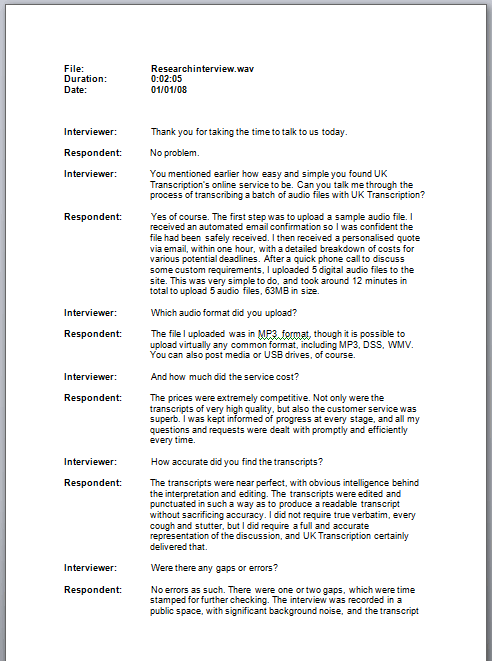
Our workshop was on transcripts and paper editing. I knew about transcripts as I was going to work for a transcript job but I didn't know what was paper editing. I could take a guess from the name but I didn't know fully. 

Peter talked us through what a transcript was. It's basically a written down version of your interview with time codes included so that it makes for easier editing. Peter told us it could save us hours when editing. I don't really see the point as I think the effort you put into writing up the transcript, you could put it into editing. But I'd like to try it and see if it works.

Transcript example


Peter continued on about editing with paper. This is where you write your clips down on paper, typically sticky notes as it makes it a little bit easier, and arrange them as if you would arrange your clips on a video editing software timeline. 

Example of paper editing

He also taught us to shoot with the edit in mind, so shoot how you want to edit it. And always capture ambient sound. This is to capture the sounds of the place where you're filming.

We were taught briefly about editing, but we have an editing workshop next week so we'll learn more. But we have been told to:

  • Build up your timeline
  • Start with rough interview edits
  • Work to a rough timing
  • Cut it down - take out the pauses and repeats. Which means no umm's or err's
  • Select cutaways to cover cracks but not wallpaper it
  • Piece of imagery must be integral to narrative i.e. don't have a dentist talking and cutaway to a piercing studio
  • Work on an opening/ending that has impact
My group are going to meet today so we can plan what we're doing and hopefully shoot soon

Sound Entry #6 - Vox pops with people in Brighton

Here is my link to my vox pops in Brighton. I couldn't decide between either one as the music I felt both suited the interviews.

https://soundcloud.com/benjamin-martin-eagle/sets/vox-pop-mouth-brighton

I have researched another podcast similar to the Youtube gaming duo, "The Yogscast" one. It is the RoosterTeeth podcast. I have listened to them before and I am familiar with their work.

Here is a link to the work I am reference:

Starting the video you can easily see that this is a more professional setting for a podcast. I will go through the points about why they have a professional setup whilst comparing it to the Yogscast.

- They have ads playing, although not helpful in sound design, it does display they are seen as a company that other companies want to do business with and run ads on their content.

- They all use professional microphones with boom arms. The professional microphones means they will give cleaner audio than the yogscast as an example, as they use gaming headsets. The boom arms also means that sounds that could be capture with headsets will not be. Handling noise would be an example.

Saturday, 21 February 2015

Video Entry #7 - Reading Notes

Video Microphone

Using the fishpole
- Held high: Tiring if held high for long. Shadows of the microphone may be unavoidable
- Underarm support: Favoured for some situations, however can pick up background noise easily
- End on ground: Comfortable for sustained shooting. Best for stationary objects

Microphone distance
- Mirophone should suit the size of the shot

In our documentary, we aim to use a fishpole overhead or underarm to get the audio as most filming is going to be done inside, so things such as birds or seagulls above won't pick up on the audio. We will use a shotgun microphone to record the audio. We would like to use the lavalier microphone, however it is rarely in stock on SISO and I forgot myself to book it.

Practical Lighting

- "As we shall see, there are many situations where just one lamp, or a well placed reflector, is all that is needed to make a picture spring to life. Even where production is on a larger scale, foresight and imagination can often make a little light go a long way. It is chiefly a matter of knowing what you are aiming at, what to look out for, and what you can do about problems you meet."

- "'Lighting' involves a lot more than simply having enough illumination around to let the camera see what is going on. Light influences what your subject looks like, how people feel about what they see, what attracts their attention. So we need to think about not only where to put our lamps, but the sort of light we are getting from them, and how all this affects the quality of our pictures."

- "Because the sun is so distance, it behaves as a localized point source of light. Its rays are therefore very directional and travel to us in straight lines. They cast distinct sharp shadows, which emphasize the texture and contours of any subject, especially when the light falls at an oblique angle...Many, man-made light sources, such as a match, a candle or a bare light bulb, also behave in this way. Because they are of very limited size, they act as point sources and produce hard light."

- "Diffused light scatters in all directions. It occurs naturally, when the sun is obscured by cloud, and whenever sunlight is reflected from rough light-toned surfaces."

We don't intend to not use any other light sources that the ones available to use as they are bulky and we are wanting a natural feel to the documentary. If there are lamps available where we go, I'm sure we will take advantage of them, however it is not a necessity in my opinion. We will attempt to try to illuminate our subjects so they appear approachable and inviting rather than casting shadows on them from harsh lighting. As stated, we will be inside for the majority of the filming, especially the interviews so we will only need to diffuse the lamps, should be choose to use them.


Interviews

- "Try to choose an interviewee who is able to express themselves succinctly and who you think will not be unduly nervous in front of the camera."

- "Prepare your interview, think what you want to know and why"

- "Always introduce the interviewee...Tell why he/she is there or why you want to interview him/her"

When choosing an interviewees, we will go for the ones that seem friendly, have a good personality and appear to be natural when being filmed. We will have to gather as a group and write out questions on what we think we will need to add to the documentary. We will have them introduce themselves. This makes it so they're more relaxed to be in front of the camera as well.

Recording sound

- "Sound recording is often one of those most overlooked parts of the production process, especially in video production. Unlike radio, video and television demand that microphones are hidden away from the camera whenever possibly, but, crucially, you also need to keep your sound synced with the camera."

- "Sync sound means simply that what is being said synchronises with the movements of the mouth. When a speaker your audience can see is out of sync, you risk parodying all those badly dubbed Kung Fu movies, not (necessarily) good."

We will do our best to record the best quality sound we can. Obviously there will be hiccups as this is our first time but we plan to not let the microphones be seen as to appear professional. We plan to use the Sony HVR-Z1E which has the sound built into the video recording so it should be okay. But if we have to use a separate audio recorder, we will have to sync the audio in post-production. 

Friday, 20 February 2015

Video Entry #6 - Homework task "Pitfalls of Independent Living"

We were given a homework task to do a 2 minute mini-documentary on either the "Pitfalls of Independent Living" or "My first day at Sussex". Our group chose to do the "My first day at Sussex". We went out and filmed people we knew and some people who we just asked as they were walking past. I interviewed the person we did not know. It was quite interesting being in the position of interviewing people. Peter had taught us techniques of how to sit and use their body language, not saying anything but using facial expressions and nodding to communicate and how to ask questions. My interview did not go especially well, the girl was nervous and kept looking at the camera. We needed to have brought the camera closer to the interviewer. It was also a silly mistake but the microphone can be seen in shot. We could have cropped it out in post, but in the real thing, you don't want this to be happening. At least we did it in practice and not the real thing.

We then went and imported the footage onto the Mac from the tape which was a new thing to me and I was a bit tentative about pushing a tape which had our precious footage on it, into something I didn't know which way it went in. But we got it onto the Mac and tried to edit it in Premiere Pro. The footage was slow and lagging. When we dragged the clip onto the timeline, it said the settings needed to be changed to match the footage, and we did just that but it was basically, un-editable. So we will need to speak to Peter about that. 

We edited on iMovie though, just to get a hands on feel with editing software. I've used Sony Vegas and Premiere Pro in the past, so iMovie was something new to me and I disliked every bit of it. Editing was such a hassle on this software. But we tried to make at least a rough cut of our footage. Unfortunately when it came to the lesson, the map of what we had done was on the timeline but the actual footage wasn't so it was kinda awkward in class. But we just need to look at what we did wrong in the practice and learn from it and carry on.

Here's a picture of George operating the camera when we were filming


Thursday, 19 February 2015

Sound Entry #5 - Vox Pops

In class this week we were doing Vox Pops although at first I thought they were called Voc Spots. But Voc Pops are interviewing the public on topics. Our in class exercise was to interview students on campus about something affecting them on campus. I chose to go into Eat Central and ask what students thought about it. 

Here is the finished product with intro and outro music and a bed for the interviews:

https://soundcloud.com/benjamin-martin-eagle/vox-pop-practice-no1

I was a little nervous at first going to interview people. Mainly because I was on my own in the exercise, with the rest of the class partnering up with each other. I also didn't mean very confident going into the cafeteria with all the equipment and looking a bit silly going round. I think if I was getting paid to do it, I wouldn't care half as much. 

When interviewing people, I did find it hard at first as I'd usually forget the questions or have a hard time asking the questions to people and not following up and being lost to pursue the answer they had given me. I think as well, if I was going to do this exercise again, I would not choose somewhere like Eat Central as this is where pretty much everyone goes there to eat so I was interrupting people with their meals and most were in groups not alone, so it made it a bit more nerve wracking doing it that way. Another point is that, although it may sound political correct, I think I'd choose to mainly just ask mainly just people of English speaking descent. I did try to ask people of Asian descent but I was brushed off with "My English is not good" and other such things. Which seems strange to me that in a majority speaking English country, you wouldn't know English that well. This also meant that rejection was more prevalent and it made me more nervous.

In regards to the reading homework, we have been given, "Speech Packages (Radio in context), I did enjoy this week's reading. I felt it gave a good, well informed view of what radio interviews are all about and how to approach them. Examples being the "Finding the angle" where it would be good to draw a mind map of what to cover and and who to ask. And then how you're going to record. For example, in a studio, over the telephone or out on the street. I believe this will help a lot for the final interview we have to do.

For this week's listening I have chosen a podcast I'm well familiarised with. However I will choose one next week where I'm not, for example, Radio 3 or 4. But I have chosen the "Yogpod" by The Yogscast. 


Link to the podcast I have chosen:

https://www.youtube.com/watch?v=w9tlMGwbv00

The basis of the show is that it is two guys from a Youtube channel called "The Yogscast", initially talked about and added extra audio content that wasn't on their Youtube channel. It then later divulged into them talking about other stuff and it becoming a show in itself. From the beginning, there's no set thing that they're going to talk about and regularly go on tangents. One of the host's may have a plan but it often does not go to plan. So comparing this to something like "The Jeremy Vine Show" on Radio 2 which is highly structured and conforms to a time limit, it is the complete opposite of it. 

Again, comparing it to live radio, this podcast may be recorded live but it is heavily edited, sometimes even having hours or days between different talk segments. Another noticeable sound difference between this podcast and a professionally produced show is the quality of the sound. For example, radio shows are produced in expensive studios with the best equipment. This podcast is two guys with headsets talking over Skype. Although to me, it is perfectly fine to listen to as there is nothing major that puts you off about it, but it might not be fit for radio broadcast. 

Again, a lot of radio shows have intro and outro jingles that have been professionally produced by experts whereas this podcast uses jingles sent in by fans. Something I feel this podcast had over radio was the way they were able to interact with their audiences. They would answer their questions about their personal lives or things that were happening with the Youtube channel and have fan submissions or donations talked about on air. This couldn't really happen on radio as there are too many listeners or they've got to keep their personal lives separate. 

For this week's homework, we had to go into Brighton and interview members of the public about a topic. I have chosen to do the topic on the mouth and have interviewed people. I will edit it and include it in a new blog post.